Showing posts with label book. Show all posts

Wednesday, August 22, 2012

Solitary Mingling

I kind of rushed to the end of this book as I had to return it to our local library, but I did enjoy reading Sherry Turkles "Alone Together", as I did "Life on the Screen" over a decade ago. She raises important questions relating to the potential quality difference between friends IRL and on Facebook. To the point of sounding like an bore, but that is kind of the point: the attention span needed to contemplate these issues is too long for the always-on-the-net (tethered) person.

The subtitle of the book may not be fully appropriate. While she makes clear that people do seem to expect less from each other, the expectations of what technology has to offer are not all that high, except for the robotic part when technology is not just a communication medium (and maybe AI in games). Overall expectations seem lowered, the desire to live life to the fullest diminished to a compulsive need for experiences worth posting.

She also makes an interesting point about privacy being one of the requirements for dissent and thus a functioning democracy. Self censorship can be almost as big a threat to public discourse as an uninformed and uneducated public.

On a lighter note, I could probably have finished the book a lot faster had I not picked up a used copy of Neal Stephensons "Anathem" from that same library for twenty five cents.

Monday, June 4, 2012

Technicum Artis Magistra

Since I have to return it to the our public library tomorrow I finally finished reading "What Technology Wants" by Kevin Kelly. A book that starts out as promising as this one, putting the door ajar to a novel outlook on the way things are, the end almost had to disappoint. It does not explain what technology wants. It is filled with a smorgasbord of interesting tidbits, and does contains a very interesting thesis that the whole of technology, for which he coins the term "the technicum", is simply the next logical step in the evolution of things that started with the big bang. A lot of brilliant minds were consulted and that shows, it is a very interesting read. And when you name Brian Eno in your acknowledgements, the man whose work first showed me that video can be Art, you cannot really go wrong, can you?

The show where I saw that greatly inspiring work by Mr. Eno was "The Luminous Image" in the Stedelijk Museum in Amsterdam. I saw it as a wee lad in 1984 (yeah, right). Here is a very low quality video of him talking about the piece I saw back then:


I still have the catalog.

Saturday, September 24, 2011

Free Culture!

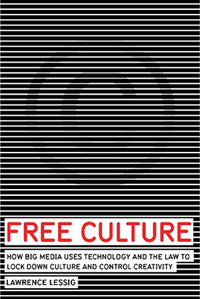
I recently finished reading "Free Culture" by Lawrence Lessig. The actual book from our local public library, not the freely available PDF - that site seems to be down unfortunately. Even though it is written by a law professor, the book from 2003 is a pretty good read. I wonder how depressing the time since then must have been for him, as things have not gotten any better with the presumption of innocence being totally disregarded with the increase in corporate police state like things as the DMCA Takedown notices


Copyright is a subject that has had my interest for quite a while. While at Ohio State I created a website called "CopyRight/CopyWrong" for a class I took ("Cyber Theory and Practice"). At filmschool our brilliant but pedagogically challenged professor Wim Verstappen taught us how to put the © sign in the right place and urged us to always use it. I have put it on all my work since. I am seriously considering changing that by adding the extra c and re-releasing everything under the Creative Commons license, probably CC BY-NC-SA. Stay tuned!

Thursday, December 9, 2010

Wrapping up


This semester has been a busy one. With the addition of a course at Pratt to my half time job at Montclair State, I have basically been teaching a full load. Only one more class session to go, and then its finals. Pfew…


I think I have also finished main part of the latest rendition in a series: "Multi Dimensional Eye Virus 3d". I need to add title, credits and (very important!) sound. So it may be 2011 by the time it is completely done.


I have also finally finished reading Spinoza's "The Ethics"

Friday, January 8, 2010

Wishfull Thinking


I opened up Gene Youngblood's "Expanded Cinema" once more and was amazed by the optimism in the book (it was published in 1970). On page 260 he writes about the coming expansion of the amount of channels available to viewers and how the advent of Community Antenna Television (CATV) will offer customers as many as eighty additional channels. He states: "Much of this programming obviously will constitute the personal aesthetic work to be discussed in this book". Video art on cable, multiple channels of it no less? Sweet! But didn't happen of course&hellip

The closest thing to a channel of time based art I have seen was broadcast on local cable in Amsterdam in the nineties and only at night time. That broadcast encouraged viewers to tape the entire show, stating "Steal This!". There may be quite a few now obsolete VHS tapes out there filled with Video Art.

Wednesday, January 6, 2010

Now I get it!


I always enjoyed animation but now I should also be able to comprehend its deeper meaning. Last night I finally finished reading Paul Wells' "Understanding Animation". There seems to be quite a bit wrong with it, but that did not keep me from enjoying it. There are not that many books out there taking a serious look at animation. If you do not mind having to skip pages, you can read most of in on Google Books


I did find it rather odd that he often referred to an animation as "text". Somehow his tools are not entirely adequate for the subject matter. Maybe that is why he in those instances focuses on animation which can be described, whose story can be translated into words. Cartoons that is. The book does cover a lot more though!

Sunday, June 8, 2008

$1 Treasure

Yesterday, after escaping the first heatwave of the year into the New Museum to see Paul Chan's great show called "7 Lights" (Flickr), we happened to run into outdoor book sale. In the sweltering heat people were filling cardboard boxes with books to buy. Who says nobody reads anymore? It might have helped that each book was only one dollar.


It was a sale for a good cause. Amongst the donated books I found one by a favorite author of mine: H.G.Wells. I have actually only ever read his classics, but just had to buy this one. It is a first edition of "Mr. Brittling Sees it Through" from 1916, the year it was first published. It must have been a bestseller right away, since it was reprinted ten times within two months. Another nice detail: according to the adds included at the end of the book, an edition like this would have cost about $1.50 at the time. So I got it fifty cents off after more than ninety years!


On the photo you can see it was still 83 degrees when we got home (thats 28 Celsius). Inside.

Tuesday, November 13, 2007

Zotheid

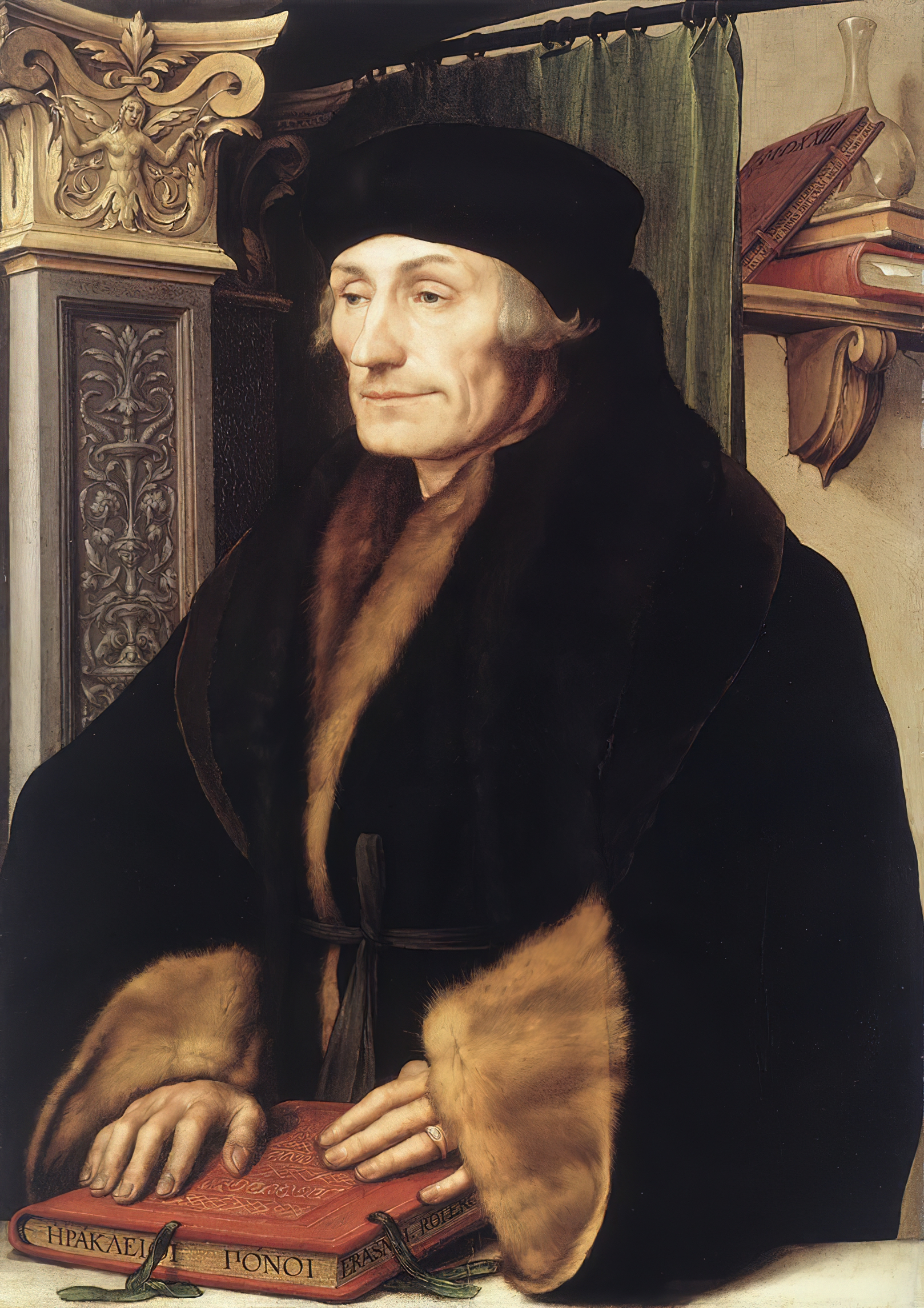
Finally got around to reading one of the classics that has been om my list for... dare I say decades? I bought a second hand pocket book of Erasmus his essential works a while ago, containing the one I read: "The praise of Folly". The Dutch title actually has a nicer ring to my ears: "De lof de zotheid"


Reading it, everything seemed quite familiar. Okay, the book is almost half a millennium old, so I should not be surprised. But I think that its reasoning has become so engrained in Dutch culture that reading the book is akin to meeting an old friend. And that's always enjoyable!


I did not know he was friends with Thomas More, whose Utopia is a classic still on my to read list. Time for the bookstore!

Thursday, May 31, 2007

Computer Brain

I'm reading a curious little book called "the Computed and the Brain", written by John van Neumann (the godfather of he modern computer ?). It was written right before his death in 1957. Half a century ago the modern computer was just moving from vacuum tube to transistors, but it's funny to read that the basic principles didn't change much and that he anticipated many of the developments that came later.


As a mathematician he has a kind of peculiar way of looking at the brain. He states that the location of memory "organs" has not been pinpointed. He does not take a Cartesion view (like "I remember, therefore I was") but deduces the existence of memory in the brain from the fact that no modern calcuating machine can function without it. Very amusing how he almost seems to take the computer as a measure for the brain in stead of the other way around.

Thursday, February 15, 2007

Kader revisited


A week ago I blogged about this book I read, and the cover featuring a dike with a whole in it, which I found rather peculiar. According to my mother this dike can actually be closed, there's some kind of door in it. So it is extremely Dutch: an engineering solution to keep the water out. Yes, it's been a while since the Dutch used their finger for that. The funny thing about the story of the boy with his finger in the dike is that here in the States everybody knows it, while I can't even remember the boys name ("boy dike finger" in Google gave me 144,000 results and the name Hans Brinker)

Friday, February 2, 2007

Kader


Doodle
Finished reading the book my parents gave me when they visited here last autumn. An insiders view on the recent history of Iran, the story of an extended family of which a slightly unrealistic number of members happen to be at key places at key times at the turbulent events surrounding the Islamic revolution. It is called "Het huis van de Moskee" ("The house of the Mosque"), by Kader Abdollah, an emigrant (or refugee) from Iran living in The Netherlands (he wrote the book in Dutch). Somehow far more interesting than the books I read from other Dutch writers lately, because of his personal history he definately has a story to tell.


I find the choice of image for the cover somewhat peculiar. It shows something that is extremely Dutch: a dike. But one with a whole in it and a road running through. The suggestion of secrets hidden behind the dike, hinting this book may reveal some of them. Intriguing choice for a book about Iran. The author has written the book for a Dutch audience. He must feel we have more in common with the people in Iran than we think.


Doodle
The silly drawings that accompany this post? Last Wednesday, during the ACM NYC SIGGRAPH Board of Directors meetings, I couldn't help myself and doodled a bit. Somehow it helps me to listen. Wasn't the only one, by the way. It is a graphics organization after all.